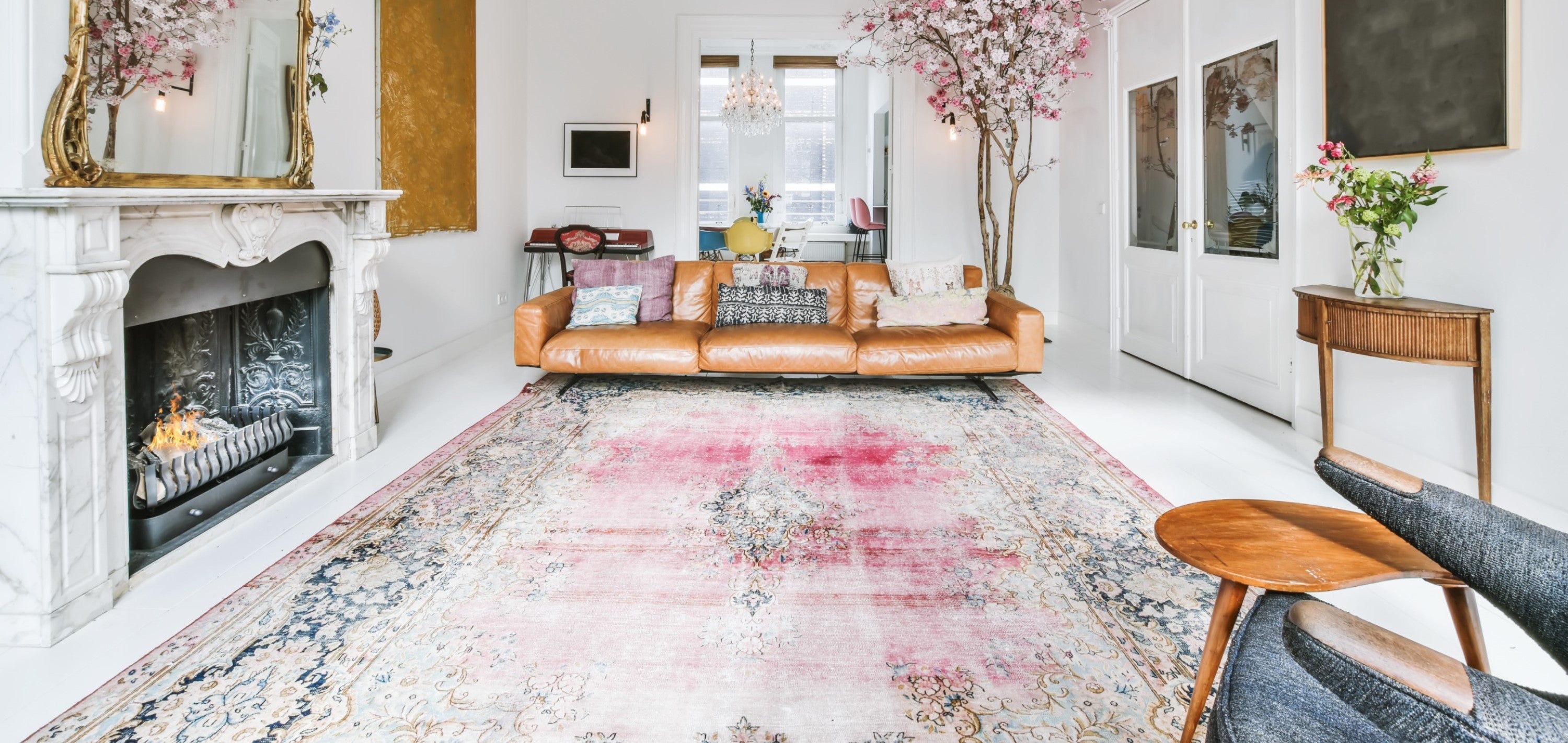
A rug of the wrong size is the most common interior design mistake — and also the easiest to prevent. Too small? The room feels disjointed, as if the rug is "lost" among your furniture. Too large? The space will feel cluttered. In this guide, I will show you which size truly works for every room, with concrete dimensions in cm and the golden rules that apply everywhere.
The three golden rules
Before we dive into the rooms, here are three rules that always apply:
- A rug connects furniture — it doesn't just sit "next to it." A rug that is separate from your seating area or dining table creates visual distance. The best result: the rug "supports" your furniture.
- Leave 20-40 cm of floor exposed between the rug and the wall. Being too close to the wall feels cramped. Too far away feels arbitrary.
- When in doubt: go bigger, not smaller. Nine out of ten people who regret their choice later realize they picked one that was too small.
Rug in the living room
The living room is where most people get stuck when choosing a size. Count on a minimum of 200×300 cm for a standard sofa-coffee table combination. Three typical scenarios:
Scenario 1: Sofa against the wall
Your sofa is against the wall or in a corner, with a coffee table in front. The rug should extend at least 20 cm under the sofa so that the front legs are on the rug.
- 2.5-seater sofa → rug 200×300 cm
- 3-seater sofa → rug 240×340 cm
- Sectional sofa → rug 240×340 or 280×380 cm
Scenario 2: Sofa floating in the room
Your sofa "floats" in the room with walking space behind it. In this case, all your furniture (sofa, armchair, coffee table) must stand entirely on the rug — otherwise, you lose that sense of cohesion.
- Count on 240×340 cm minimum, often 300×400 cm
Scenario 3: Small seating area or two-seater
A more compact seating area with a two-seater or armchair next to the sofa fits well on smaller sizes:
- 170×240 cm to 200×300 cm
View large rugs for the living room » or all vintage rugs »
Rug under the dining table
The critical rule here: the rug must be larger than your dining table plus at least 60 cm on all sides, so that chairs remain on the rug even when pulled out. There is nothing more annoying than a chair leg slipping off the rug constantly.
A few common combinations:
- Dining table 160×90 cm → rug 280×190 cm
- Dining table 180×90 cm → rug 300×210 cm
- Dining table 200×100 cm → rug 320×220 cm
- Round dining table Ø120 cm → round rug Ø 240 cm
For a dining room, a kilim or low-pile vintage rug is often the smartest choice — chairs slide easier over the flat structure than over high-pile rugs.
View handmade kilims » or large rugs for under the dining table »
Rug in the bedroom
Two approaches that both work beautifully:
Option A: One large rug under the bed
The bed stands entirely on the rug, with 50-70 cm of space around it where you place your feet in the morning. Concrete sizes:
- Single bed (90×200) → rug 170×240 cm
- Double bed (140×200) → rug 240×330 cm
- Double bed (180×200) → rug 280×380 cm
Option B: Two narrow rugs next to the bed
A narrow rug or runner on both sides of the bed — a luxurious feel without needing the entire furniture piece on it. Size per piece: 60-80×150-200 cm. Works especially well with two identical kilims or romantic pink or beige vintage pieces.
View pink vintage rugs » or narrow runners for next to the bed »
Runners in the hallway or kitchen
For a runner, the rule is: narrow and long. Two rules of thumb:
- Hallway: 80-100 cm wide, length = 50-70% of the hallway length
- Kitchen: narrow runner (60-80 cm) in front of and perpendicular to the countertop, NOT pushed against the walls
Always leave 20-30 cm of floor free at both ends so the runner has "breathing room" and doesn't look jammed in.
View handmade runners for hallway and kitchen »
The 5 most common mistakes
Avoid these pitfalls:
- Choosing too small because a large rug is more expensive. A small rug in a large room looks cheaper, not better. It is better to have one good, larger vintage piece than two wrong sizes.
- Sofa legs half on, half off. Either everything on the rug, or only the front legs on it. Half-and-half looks messy.
- Dining room rug exactly the size of the table. Chairs will slide off the rug. Always leave at least 60 cm extra on all sides.
- Runners pushed against the wall. A runner should lie "freely," not be wedged in.
- Mixing multiple shapes in a small room. Stick to one main shape — usually rectangular.
Shape: rectangular, round, or square?
- Rectangular is the all-rounder. It works in 90% of cases.
- Round comes into its own under a round dining table, or in a corner where you want to create a visual focal point.
- Square is rare but powerful — under a square dining table or in compact square seating areas.
Frequently asked questions
My room is irregularly shaped — what size?
Measure the "central zone" where you live (e.g., between your sofa and the TV cabinet) and choose a rug that is slightly larger than that zone. Ignore corners and protrusions in the room.
Vintage rugs are not always standard sizes — is that okay?
That is actually a plus. Vintage is by definition unique — sizes like 195×285 cm or 210×310 cm are normal and actually have more character than strict industrial sizes. In our collection, you can filter by the exact length and width that fits.
High-pile or low-pile?
Low-pile (such as vintage and kilim) is practical in dining and workspaces — chairs roll more easily. High-pile is more luxurious in a bedroom or seating area context.
What if my ideal size just doesn't exist?
A vintage rug is by definition unique. Is it 5-10 cm different from what you had in mind? No problem — it often works even better because it feels more organic.
Conclusion
Choosing the right size is not a matter of "feeling," but of three simple rules: connect your furniture, leave breathing room around the walls, and go bigger rather than smaller. With the dimensions above, you have a concrete foundation. Still in doubt? Take a look at our size guide with visual examples per room, or filter directly by exact length and width in our vintage rug collection.
Do you have questions about a specific room or furniture arrangement? Email us — we are happy to provide personal advice on which size fits your situation.