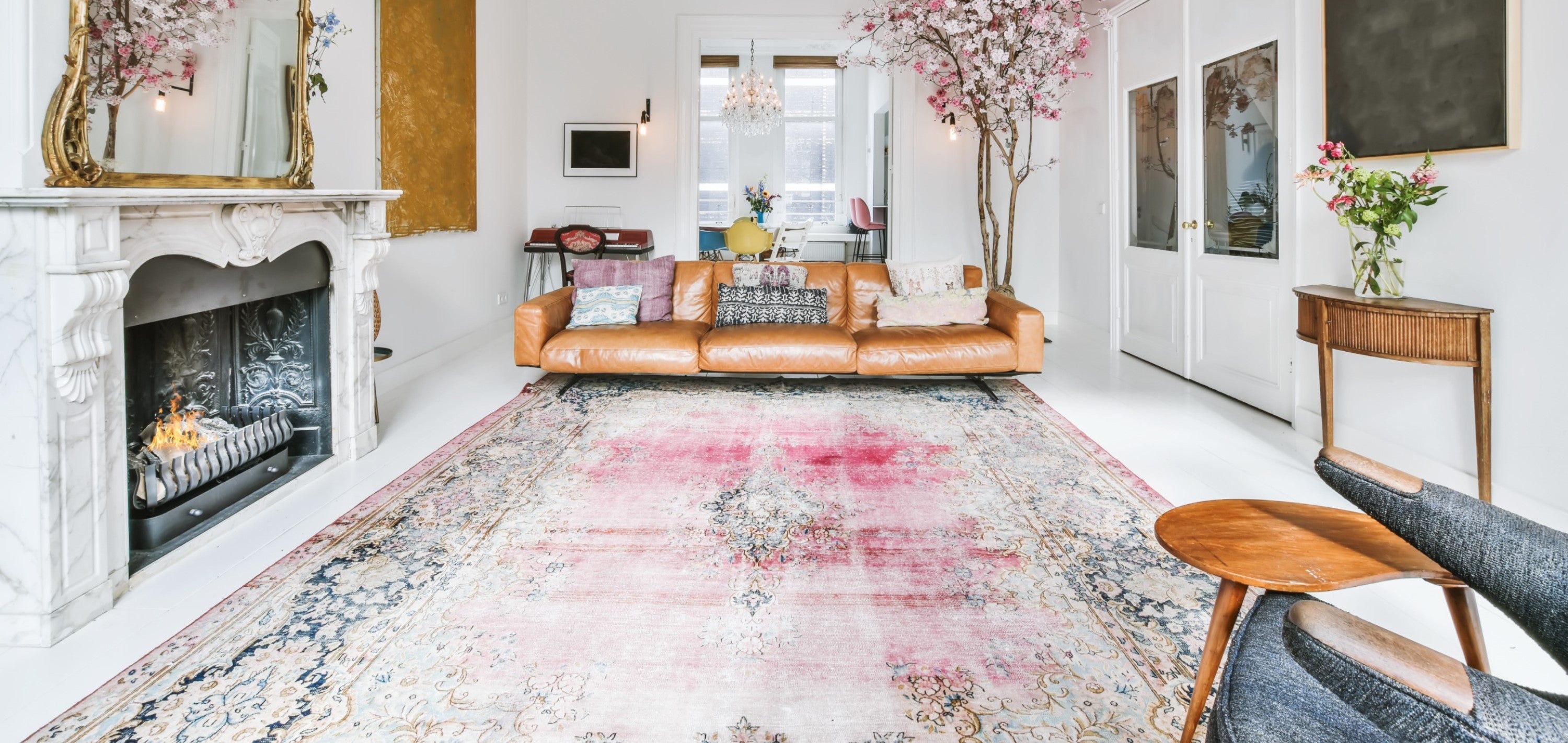
Two rugs in the same space — also known as "layering" — is one of the most influential interior design trends of recent years. It’s not just for the boho style: it also works for Scandi, modern, and eclectic interiors. In this guide: when to do it, and how to do it without it looking cluttered.
Why two rugs?
Three reasons why it looks great:
- Depth. A large, simple base layer + a smaller statement rug on top = visual layers that add more character than a single large rug.
- Zoning. In an open-plan space, you can use layering to visually define a seating area.
- Budget. A very large (3×4 m) vintage rug is expensive. Two smaller ones that overlap = a comparable effect for less.
The 3 layering formulas that always work
Formula 1: Large solid base + small, pattern-rich vintage top
A sisal or jute mat (3×4 m) as a base, with a colorful vintage piece (200×300 cm) layered over it. The pattern "floats" on the neutral background. Works in: boho, Scandi, eclectic.
Formula 2: Two vintage pieces with overlap
A large vintage rug (200×300 cm) as a base, with a smaller kilim (100×150 cm) partially covering it. Requires courage with color combinations: choose rugs that share at least one main color.
Formula 3: Runner over rug
A broad base rug in the bedroom, with a narrow runner along the bed layered on top. Practical (where you walk often) and aesthetic.
The 5 layering mistakes
- Two equally busy patterns. One must be quiet; the other can be bold.
- No color relationship. At least one color should be shared by both rugs; otherwise, it looks accidental.
- Two high-pile rugs. Feet sink in; it feels unstable. Always combine flat (kilim/sisal) with low-pile vintage.
- Two rugs of equal size. The effect works through differences in scale. One must be clearly larger.
- Too much overlap. Maximum 50% overlap; ideally 20-40%.
Style combinations by interior
- Boho: colorful kilim on natural jute
- Scandi: light beige low-pile vintage on white sisal
- Industrial: reddish-brown vintage on dark solid base
- Classic: soft pink vintage on a large solid background
Where does it work, and where doesn't it?
✅ Works well: living room (seating area), bedroom (beside the bed), large hallway, reading nook.
❌ Works poorly: dining room (chairs will snag), kitchen (too much foot traffic), small room under 12 m² (visually busy).
Concrete steps for your own layering
- Start with your largest solid-colored rug (sisal/jute/large vintage)
- Choose a smaller statement piece — at least one color that matches
- Place with 20-40% overlap, in a corner or along the seating area
- Step back a meter. Is the balance right?
Our vintage collection and kilims are excellent for layering. Combine a neutral gray or beige piece with a colorful kilim for the best effect.