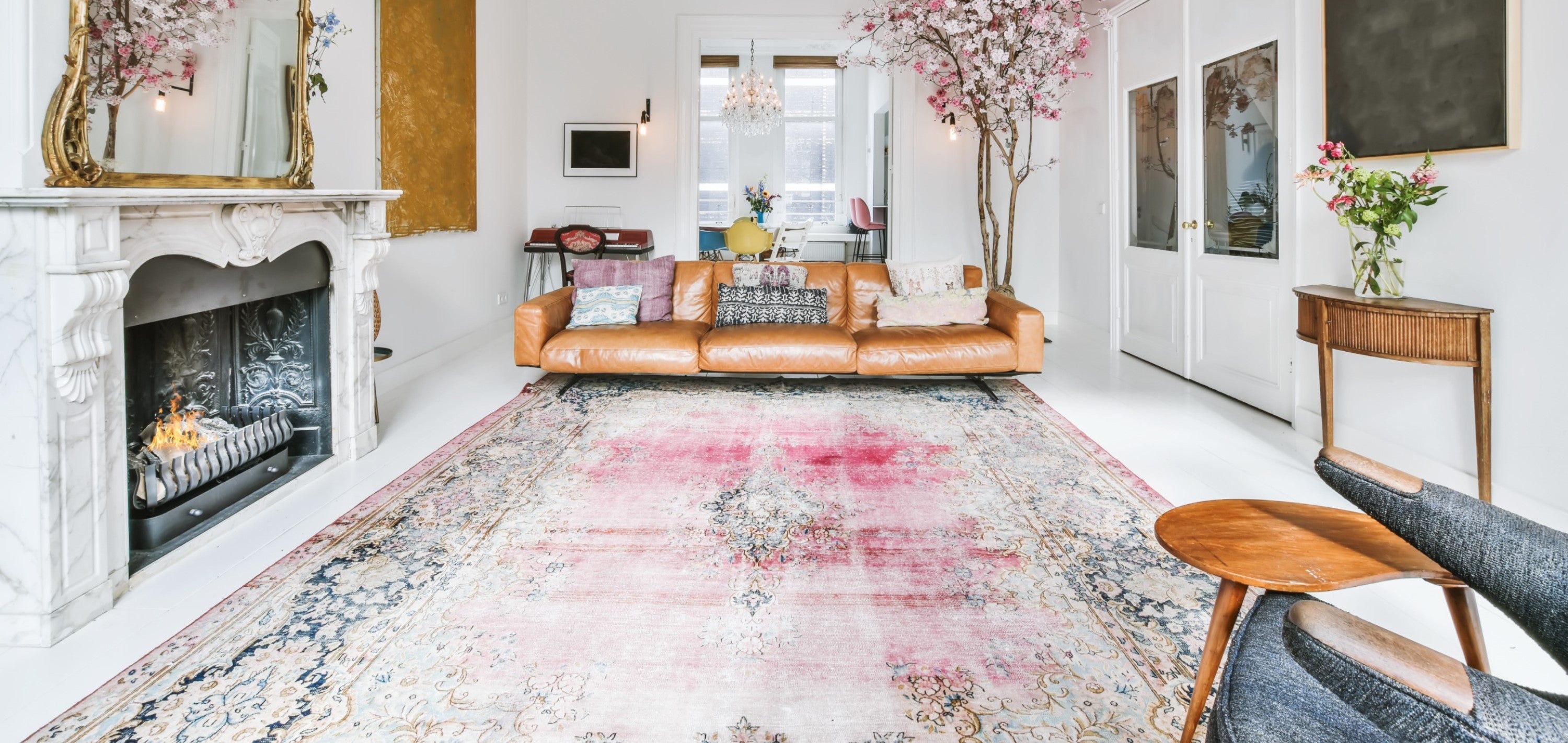
You're scrolling through Instagram, see a beautiful vintage Turkish rug for 199 euros, click through, pay — and three weeks later, a thin, synthetic rug that looks nothing like the picture arrives in your hallway. Welcome to the dark side of the online vintage rug market. In this article, we list the nine most common pitfalls, with concrete checks that can save you hundreds to thousands of euros.
1. Photographic Deception: Color Saturation and Filters
Vintage rugs often have muted, complex colors — a faded salmon pink, a grayish-blue with a green undertone, an earthy red with patina. But in poor product photos, these suddenly become a vibrant red or a neon blue. With a slider in Photoshop, a dull rug is visually "polished" into something it's not.
Check: Always see if the seller shows at least one photo in natural daylight, and one photo in a real room (instead of just on a white studio background). If in doubt, ask for additional photos. Anyone who refuses has something to hide.
2. "Vintage" Without an Age Claim
The word "vintage" is not a protected term. Anyone can use it. Some sellers market rugs that are 5 or 10 years old as vintage — in reality, that's just "used." Truly vintage starts at around 20 years, and the real sweet spot is 40+ years.
Check: Specifically ask for an age estimate, with justification. A reputable dealer can quite accurately identify a period based on wool, colors (natural dyes vs. synthetic), motif, and knotting technique. For more context: read our price guide for vintage rugs, which explains the age categories.
3. No Origin Information
A vintage Anatolian rug comes from somewhere. Konya, Sivas, Oushak, Kayseri — each region has its own signature. Anyone who says "Turkish vintage rug" and then can't name a region probably doesn't know what they're selling or is importing anonymous container rugs.
Check: Ask for the region and, if possible, the village. A serious dealer will answer without hesitation. Want to learn how to recognize where a rug comes from? Read our guide on Anatolian regions and their distinguishing features.
4. Machine-Knotted Sold as Hand-Knotted
This is perhaps the most common scam. A machine-made rug with a "vintage finish" (chemically bleached to look old) is sold as hand-knotted, often on marketplaces or via dropshipping pages from Asia.
Check: Ask for a photo of the back. With a hand-knotted rug, you can clearly see the individual knots on the back; with a machine-made rug, the back is perfectly regular and smooth, often with a latex layer. Read our in-depth guide on how to recognize a genuine hand-knotted rug.
5. Unclear or Misleading Return Policy
In the Netherlands, you have a legal 14-day cooling-off period for online purchases. Some sellers try to circumvent this by classifying vintage items as "custom-made" or "unique products" — this is almost always incorrect and therefore not legally valid.
Check: Before purchasing, look up the return policy. Does it state "no returns possible due to unique character"? Ask critical questions or look elsewhere. For a reputable dealer, 14 or 30-day returns are standard — including free return shipping for large order values.
6. Unrealistic Prices
A hand-knotted vintage rug measuring 250 × 350 cm for 299 euros? Let's do the math: such a rug easily contains 800,000 knots, made by a weaver who spent several months on it. Add: import, customs, storage, seller's margin. A serious price for such a rug starts at 1,500 euros.
Check: Use our price indication as a reference. Generally speaking: if a price deviates more than 50% from the market value, something is wrong. Either the rug is not what is claimed, or the condition is much worse than shown, or it's outright fraud.
7. No Contact Details or Vague Company Identity
A legitimate webshop has: a Chamber of Commerce (KvK) number, a physical address, a working phone number, customer service email that responds within 24 hours, and preferably genuine reviews on independent platforms (Trustpilot, Google Reviews).
Check before you pay:
- Is there a KvK number at the bottom of the site? Verify it with the Chamber of Commerce.
- Is the phone number Dutch and reachable?
- Are there genuine reviews older than a few months?
- Is Dutch spoken in the communication, or vague English?
8. "Authentic" Without Proof
The word "authentic" is eagerly used, even by sellers who have never seen their imports themselves. A true dealer knows their suppliers, travels to the regions, and can personally tell you who weaves their rugs or where they come from.
Check: Look on the website for an "About Us" page with concrete content — who are the people behind the store, what is their connection to Turkey, how is sourcing done? Generic marketing texts are a red flag.
9. No Explanation of Material and Maintenance
A vintage wool rug requires different care than a newly made synthetic rug. A seller who doesn't provide maintenance advice probably doesn't know what they're selling themselves — or the material is not what is claimed.
Check: See if there is a maintenance section in the product description or FAQ. We have a complete vintage rug maintenance guide that we recommend every customer to read — that's how you recognize that a seller knows their stuff.
Bonus: Trust Signals That Do Matter
- Live photos in your order. With us, you often receive video or detailed photos of the exact rug before shipping.
- Delivery by a well-known carrier with track & trace.
- Secure payment methods: iDEAL, credit card via certified gateway, no strange bank transfers to foreign accounts.
- Verified reviews over a longer period, with photos of the actual rugs in customers' homes.
- Warranty and after-sales service — a good dealer won't abandon you after the purchase.
Step-by-Step Plan for a Safe Purchase
- Make a shortlist of 3 webshops via Google or recommendations.
- Check KvK, reviews, return policy, contact details.
- For each shop, ask for additional photos of one rug you like — pay attention to the speed and quality of the response.
- Compare prices against our indications in the price guide.
- Choose the provider who convinces you on both product and service level — not automatically the cheapest.
Why a Dealer with Expertise is Worth Your Money
Vintage rugs are complex. Age, origin, condition, material — these are factors that take years of experience to assess. A dealer who truly knows what they are selling protects you from making bad purchases. That "advice component" is included in the price. Saving a few hundred euros by buying from an unknown dropshipper often means losing a thousand euros later.
Finally
Buying vintage rugs online is fantastic — you have access to a much larger stock than any physical store — but it requires a critical eye. By recognizing the nine pitfalls above, you will almost always find a beautiful and fair rug.
Would you like to browse a Dutch dealer with expertise, origin documentation, and a generous return policy? Then view our vintage rug collection or specifically the accessible kilim collection. And for the broader picture, be sure to read our complete guide to vintage rugs.