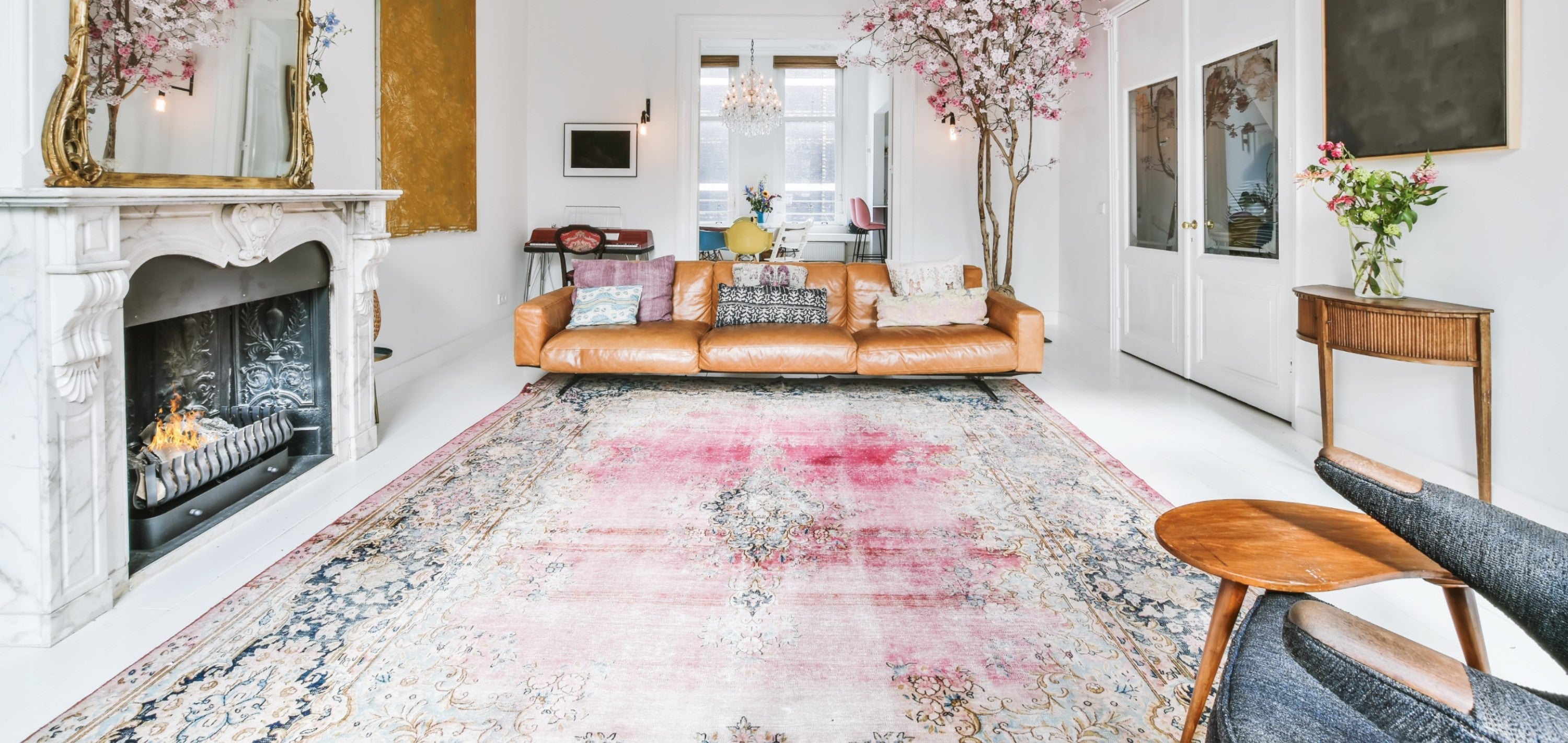
A rug on a wooden floor works best when the rug is clearly lighter or darker than the wood, and large enough to frame the seating area or dining table as a single unit. As a rule of thumb, choose a rug with deeper tones for a light oak floor, a lighter rug for a dark floor, and leave 20 to 40 cm of wood visible all around. Always place an anti-slip underlay underneath: it protects the lacquer or oil and keeps the rug in place.
Why a wooden floor requires a different approach
Wood is not a neutral background like a white resin floor or grey tile. It has its own colour, a warm or cool undertone, and often a distinct grain or plank pattern. A rug lies on top of it, so it will always create a conversation. If you choose a rug in almost the same shade as the wood, it will disappear and make the room look flat. If you deliberately choose contrast, the rug will become the anchor of the space and make the wood around it look even better.
Protection is also a factor. A wooden floor can be scratched by sand under a rug and discolour under the influence of daylight. Where the rug lies, the wood will change colour less quickly than in the rest of the room. We will come back to this later.
Which rug colour suits which wooden floor?
First look at the tone of your floor and then choose a rug in contrast. This table gives you a starting point.
| Type of wooden floor | Works well | Better to avoid |
|---|---|---|
| Light oak, whitewash, natural | Deep blue, terracotta, warm red, green, a colourful kilim | Cream and sand beige that are almost as light as the wood |
| Medium brown oak, rustic | Grey, blue-grey, off-white, pink, also bright accent colours | Orange-brown and honey tones that blend in with the wood |
| Dark, smoked or black-stained | Light beige, ivory, soft pink, light grey, a light Usak rug | Black, anthracite and dark brown, which disappear into the floor |
| Red or orange-tinted wood (for example merbau or old pine) | Blue, turquoise and green as a contrasting colour | Red, orange and yellow, which further enhance the red glow |
For dark floors, our collection of beige and light vintage rugs is a logical starting point. On a light oak floor, deeper colours really let the pattern speak. If you also want to coordinate the colour with your sofa, your walls and the light, read our comprehensive guide on how to determine the colour of a rug.
Also pay attention to the undertone
Place a sample or photo of the rug next to a plank in daylight. If your wood has a yellow or orange undertone, cooler colours such as blue and grey will often look more harmonious. If the wood is greyish or bleached, warm tones such as red and ochre will bring warmth back to the room.
Rug on a herringbone floor: calm or busy pattern?
A herringbone or Hungarian point floor already has a strong graphic pattern. You have two good options:
- Calm rug with little pattern. A faded vintage rug in one main colour lets the herringbone take centre stage. This works especially well in small rooms, where too much pattern can quickly look busy.
- Clearly different pattern. A kilim with large geometric areas or a rug with a large medallion contrasts with the small, repeating herringbone. The difference in scale makes it look calm.
What works less well is a rug with small zigzag or diamond motifs in the same size as the planks. These two patterns will compete with each other. If you are looking for a rug with large areas, take a look at our handwoven kilims.
How big should a rug be on a wooden floor?
On wood, the edge of the rug stands out sharply. That is why a rug that is too small stands out even more: it looks like an island in a sea of planks. As a rule of thumb, leave 20 to 40 cm of wood visible between the rug and the wall in a small room, and 40 to 60 cm in a large one. This way, the wood frames the rug like a matting.
Calculation example: your seating area is 4 metres wide from wall to wall and 3 metres deep, measured from the wall behind the sofa to the dining table. Leave 40 cm of wood free along each wall. That leaves 400 − 40 − 40 = 320 cm in width. At the dining table end, you want a walking path of about 80 cm, so the depth becomes 300 − 40 − 80 = 180 cm. A rug of around 300 × 180 cm will fit perfectly.
The large rugs in our collection are usually 250 to 320 cm long and 160 to 210 cm wide. This fits well under a three-seater sofa with a coffee table, with wood around it. View them in the large rugs collection.
Lay the rug in the direction of the planks
A rectangular rug usually looks calmest when the long side runs along the length of the planks. Laying it across can also work, for example to make a narrow room look wider, but make that a conscious choice.
Protect your wooden floor under the rug
A hand-knotted wool rug is inherently gentle on wood, but a few things make the difference:
- Always use an underlay. Choose felt with natural rubber. It provides grip, prevents sand from rubbing between the rug and the floor, and does not damage the lacquer. PVC underlays can leave marks on lacquered or oiled wood. In our article on the right anti-slip underlay, you can read which type belongs with which floor.
- Shift it occasionally. Wood discolours under the influence of daylight, and under the rug this happens more slowly. Therefore, turn or shift your rug a little every six months, so the difference between covered and uncovered wood remains smaller.
- Let the floor cure first. If your floor has just been lacquered or oiled, wait until the finish has completely cured according to the manufacturer's instructions before placing a rug on it.
- Also vacuum the floor under the rug. Lift the rug a few times a year and vacuum the wood underneath. Sand and grit are the main cause of fine scratches.
Common mistakes
- Choosing tone-on-tone. A honey-coloured rug on a honey-coloured floor disappears. Choose at least two shades lighter or darker.
- A rug that is too small. On wood, a postage stamp stands out even more. Better to choose something slightly larger, so that at least the front legs of the sofa are on it.
- No underlay. A kilim or thin rug quickly slides on a smooth wooden floor, which creates a tripping hazard and wear on the edges.
- Two competing patterns. A fine geometric rug on a herringbone floor makes the room look busy. Choose calm or a large difference in scale.
- Never shift it. After a few years, the outline of the rug can become visible in the wood.
Frequently asked questions
Is a wool rug good for a wooden floor?
Yes, wool is soft, resilient and breathable, and a hand-knotted rug lies firmly on the floor. Do combine it with an underlay of felt and natural rubber, so that no sand rubs.
Which rug colour suits a light oak floor?
Deeper colours work best on light oak, such as dark blue, terracotta, warm red or green. A cream or sand-coloured rug often disappears in the same light tone.
Can a vintage rug go on a herringbone floor?
Certainly. Choose a calm, faded rug if you want to let the herringbone speak, or a rug with large areas such as a kilim for deliberate contrast.
You can see all colours and sizes together in our vintage rug collection: hand-knotted from wool, decades old and each rug unique.