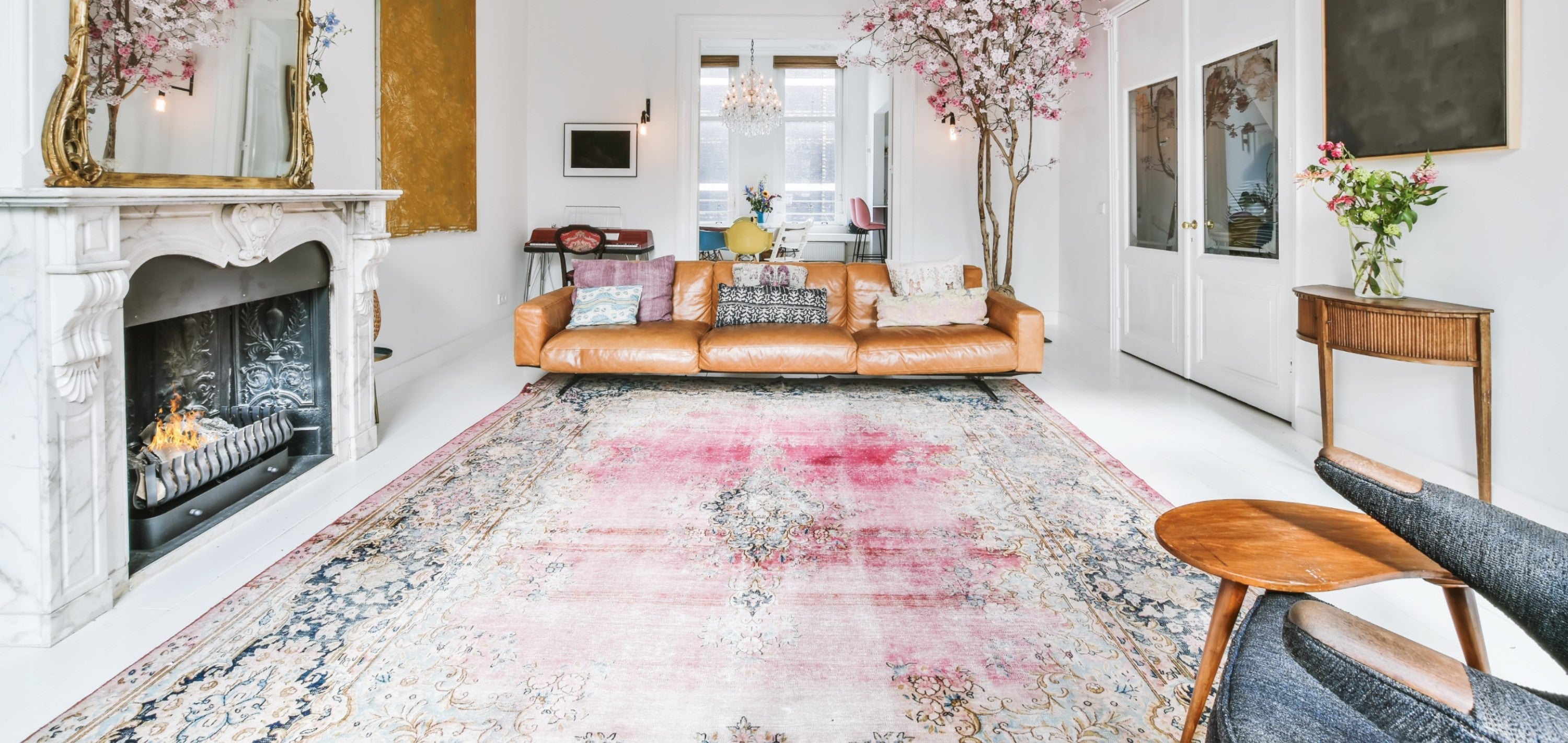
A beige rug is not boring or impractical, as long as you choose a warm shade and pattern instead of a plain, cool rug. Beige works as a calm base under almost any sofa and with any wood type, and a vintage rug with a distressed design hides crumbs and footprints much better than you expect. You get the most out of beige when you combine it with texture, one accent color, and a size that is large enough.
Is a beige rug boring?
Only if everything around the rug is also beige. Beige on beige on beige makes a room flat, because the eye finds no foothold anywhere. A beige rug actually becomes interesting through what is placed on it and around it: a dark wood coffee table, a green plant, a sofa in rust or dark blue.
With a hand-knotted vintage rug, there is even more to it. Because the rug is washed and low-shorn, you often see soft patches of old pink, light blue, sand, or brown in the beige. These color gradients provide depth that a machine-woven plain rug lacks. You get the calm of beige, with enough design to keep it from becoming boring.
Which shade of beige suits your room?
Beige is a family, not a color. You only really see the difference between ivory and sand beige when they lie next to each other. Choose the shade based on your floor and your light:
- Ivory and cream: the lightest shades. Beautiful in a Scandinavian or Japandi interior with light oak. They make a small room look larger, but are the most sensitive to dirt.
- Sand beige and pebble: a bit grayer or browner. The safest choice for families, because they hide dust and footprints better.
- Gray beige (greige): a bridge between warm and cool. Ideal if you have a gray sofa or a concrete-look floor and still want to make the room warmer.
- Beige with a second color: beige-red, beige-turquoise, or beige-brown. Then beige is the background and the second color provides the atmosphere.
A rule of thumb for light: in a north-facing room, cool ivory quickly looks gray, so a warm sand beige works better. In a sunny south-facing room, you can use the lightest cream.
Combining a beige rug: 5 combinations that work
- Beige with dark blue: a dark blue sofa or cushions provide contrast without being restless. Classic and timeless.
- Beige with green: sage, olive, or lots of plants. Together with wood, this feels natural and calm.
- Beige with cognac and rust: leather, terracotta, and copper make a light rug feel warm. Works well in a boho or rustic interior.
- Beige with black: a black metal frame, lamps, or picture frames make the whole look graphic and modern.
- Beige with gray: a light gray sofa on a gray beige rug is calm. Do add one warm color, for example in a throw.
Unsure which color should take center stage in your interior? Then read how to determine the color of your rug per interior style and per room.
Does a beige rug get dirty quickly?
A light rug shows dirt sooner than a dark rug, that's just how it is. But the difference between plain and pattern is greater than the difference between light and dark. A plain cream rug shows every coffee drop. A vintage rug with design and color gradient hides small stains in the pattern.
Wool also helps. The natural fat layer on wool fibers ensures that spilled moisture does not soak in immediately, giving you time to blot it. Vacuum weekly and turn the rug half a turn once or twice a year. In our step-by-step guide for the maintenance of a vintage rug, you can read how to deal with stains.
What you should do take into account: the location. A beige rug in the living room or bedroom is fine. Directly behind the front door, where wet shoes come in, it is better to choose a sand beige or a rug with more color.
Which size beige rug do you choose?
With a light rug, a size that is too small stands out extra: it lies like a separate patch in the room. Make sure that at least the front legs of your sofa stand on the rug in the living room. For an average seating area, that is often 200 x 300 cm or larger.
For comparison, this is how the sizes in our beige collection look at the time of writing:
| Type | Sizes in the collection | Where it fits |
|---|---|---|
| Medium | usually 200-215 x 105-130 cm | next to the bed, in a seating area with an armchair, in a study |
| Large | including 240 x 150, 280 x 200, and 290 x 185 cm | living room with a small sofa, under a dining table for four |
| Runner | 85-90 cm wide, 345-385 cm long | hallway, landing, along the kitchen counter |
Calculation example: you have a hallway of 5 meters and want to leave 30 cm of floor free on both sides. Then you are looking for a runner of approximately 440 cm. A runner of 385 cm leaves 57.5 cm free on each side and still looks like one whole.
For larger spaces, you will find more choice in the large rugs.
What you better not do
- Choose everything in the same shade. Wall, sofa, and rug in the same beige make a room colorless. Make sure there is at least one clearly darker or warmer element.
- Place a plain light rug on a walking route. Choose a pattern or a sand-colored shade for that.
- Assess the shade only on your screen. Beige shifts strongly per display and per lamp. View photos in daylight and assess the rug at home; you have 14 days to change your mind.
- Cool white light. Under lamps with cool white light, beige looks gray. Warm white light, around 2700 Kelvin, keeps it soft.
Frequently asked questions
Does a beige rug fit with a gray sofa?
Yes, especially a warm sand beige or gray beige. The beige warms up the gray, while the whole remains calm.
What is the difference between beige and cream?
Cream is lighter and has a yellow undertone, beige is slightly darker and tends toward sand or gray. Cream visually enlarges a space, beige is more practical in use.
Does a beige rug work on a light wood floor?
Yes, if there is enough contrast. Then choose a rug with design or a second color, so that it does not disappear against the wood.
Looking for a calm rug for your hallway? Also check out our runners for hallway and kitchen, including sand beige Usak runners.