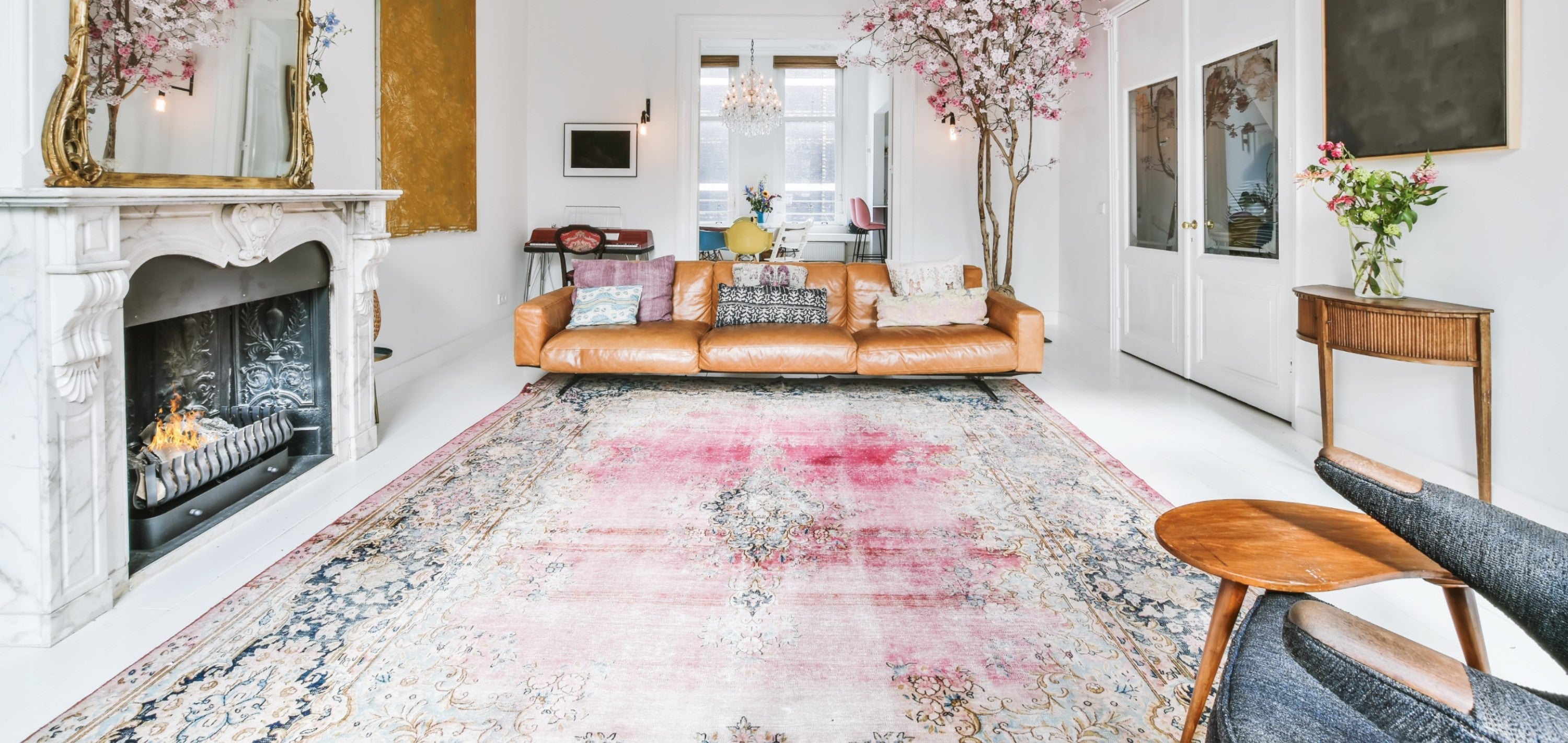
In a mid-century interior, a rug that picks up the warm tones of teak and walnut or deliberately contrasts with them—such as mustard yellow, ochre, orange, olive green, or deep petrol blue—is a great fit. Choose a low-pile rug that is large enough to accommodate at least the front legs of your sofa and armchairs, as the slim legs of mid-century furniture leave a lot of floor visible. A distressed vintage rug or a graphic kilim adds exactly the warmth these clean lines need.
What makes an interior mid-century?
Mid-century modern is the style from roughly 1945 to 1970. Think teak and walnut furniture, sideboards on tall legs, tapered legs, organic shapes, and classics by designers such as Charles and Ray Eames, Arne Jacobsen, and Hans Wegner. The colours of that era are warm and earthy: mustard, ochre, orange, olive green, and brown, with petrol and deep blue providing a cool counterpoint.
For your rug, this means three things. The wood is already warm in colour, so the rug needs to complement that. The furniture stands high on slim legs, leaving a lot of the rug visible. And the lines are clean and graphic, so a rug with some patina and irregularity makes the space feel more inviting.
What colour rug suits teak and walnut?
You have two good options: complement the warmth of the wood or contrast it with a cool colour. What rarely works is a rug in almost the same shade of brown as your furniture. Everything blends together.
| Your furniture | Works well | Best to avoid |
|---|---|---|
| Light teak, honey-coloured | Mustard yellow, ochre, olive green, petrol blue | Honey and caramel browns that blend into the wood |
| Dark walnut or rosewood | Orange, terracotta, faded pink, warm yellow | Dark brown and black, which make the room feel heavy |
| Wood mixed with white or black (such as an Eames chair) | A colourful kilim or a rug in one bold colour | A rug with many small, busy patterns |
Mustard and ochre are perhaps the most recognisable mid-century colours. A washed, low-pile vintage rug in these shades also has a distressed depth of colour that new yarn cannot match. Browse our yellow and ochre vintage rugs if you want to go in that direction.
Cool counterpoint: blue and petrol
If you already have plenty of warm wood, orange cushions, and a cognac leather armchair, a rug in deep blue or petrol blue can bring balance to the room. Blue is the complementary colour of orange, so the wood will look warmer without the room becoming a brown wash.
Pattern: graphic or distressed?
Mid-century design is all about clean shapes. Two types of rugs suit this well.
- Graphic and geometric. A handwoven kilim with large squares, stripes, or stepped blocks blends seamlessly with the graphic designs of the 1950s and 60s. Kilims are flat, so chairs and coffee tables stand securely on them. Browse our collection of handwoven kilims to find one.
- Distressed and muted. A vintage rug with a faded medallion or a calm all-over pattern provides a soft contrast to the clean lines of your furniture. The eye rests on the rug, making the furniture stand out more sharply.
Unsure whether to choose something truly vintage or with a retro look? Read our article on the difference between a vintage and a retro rug to find out exactly what you are buying.
How large should a rug be under mid-century furniture?
Mid-century furniture stands on tall, slim legs. This means you can see right through to the floor beneath the sofa, armchair, and sideboard. A rug that is too small will stand out even more, looking like an island surrounded by legs. As a rule of thumb, at least the front legs of the sofa and armchairs should be on the rug, and the rug should extend about 20 cm beyond the sofa on both sides.
Example calculation: you have a three-seater sofa that is 200 cm wide, with a coffee table in front and a lounge chair beside it. In length, you will need 200 + 20 + 20 = 240 cm, and preferably a little more to include the chair. In depth, you want the front legs of the sofa on the rug (about 20 cm under the sofa), the coffee table, and another 40 cm in front of it: together, that is around 160 cm. A rug measuring around 260 × 165 cm would be a good size.
This size is very common. The yellow and orange vintage rugs in our collection are currently available in roughly two sizes: around 200 to 240 cm long and 110 to 145 cm wide, and around 250 to 315 cm long and 155 to 195 cm wide. The smaller size is ideal under an armchair with a side table or in front of a sideboard; the larger size is better for a seating area. For other layouts, see our size guide by room.
Common mistakes
- A high-pile rug under slim legs. Thin legs sink into a thick pile, leaving an armchair sitting unevenly. Choose a low-pile or flat-woven rug.
- Tone-on-tone with the wood. A caramel-brown rug under a teak sofa makes the room feel flat. Choose at least two shades lighter or darker, or a different colour family.
- Everything from the same period. A room decorated entirely in 1960s style can quickly look like a museum. Leave room for a few contemporary pieces.
- A rug that is too small. With furniture on tall legs, you see more of the floor, so a small rug under only the coffee table will stand out even more.
- Too much pattern. If you already have patterned wallpaper or an armchair with graphic fabric, choose a calmer rug. One busy pattern per seating area is a good rule of thumb.
Mid-century on a herringbone or parquet floor
Many homes built in the 1950s and 60s have parquet or herringbone floors, and people in newer homes often choose wood for this style too. This means you have three layers of wood: the floor, the furniture, and sometimes a wooden wall. A rug in a distinctly different colour from the wood helps separate these layers. On a light oak floor beneath teak furniture, a deep blue, green, or terracotta rug often works best. Read more about combining colour and wood in our article on a rug on a wooden floor.
Frequently asked questions
Does an oriental or Turkish vintage rug suit a mid-century interior?
Yes. The contrast between a hand-knotted rug and clean design works particularly well: a distressed vintage rug brings warmth and patina to an otherwise clean-lined room.
What colour rug suits teak furniture?
Mustard yellow, ochre, and olive green complement the warmth of teak, while blue and petrol provide a cool contrast. Avoid a rug in the same shade of brown as the wood.
Is a kilim suitable for a mid-century living room?
Absolutely. The graphic patterns of a kilim suit the clean lines of the style, and because a kilim is flat, slim furniture legs stand securely on it. Do use an anti-slip underlay, though, as a kilim is lightweight and can slip easily.