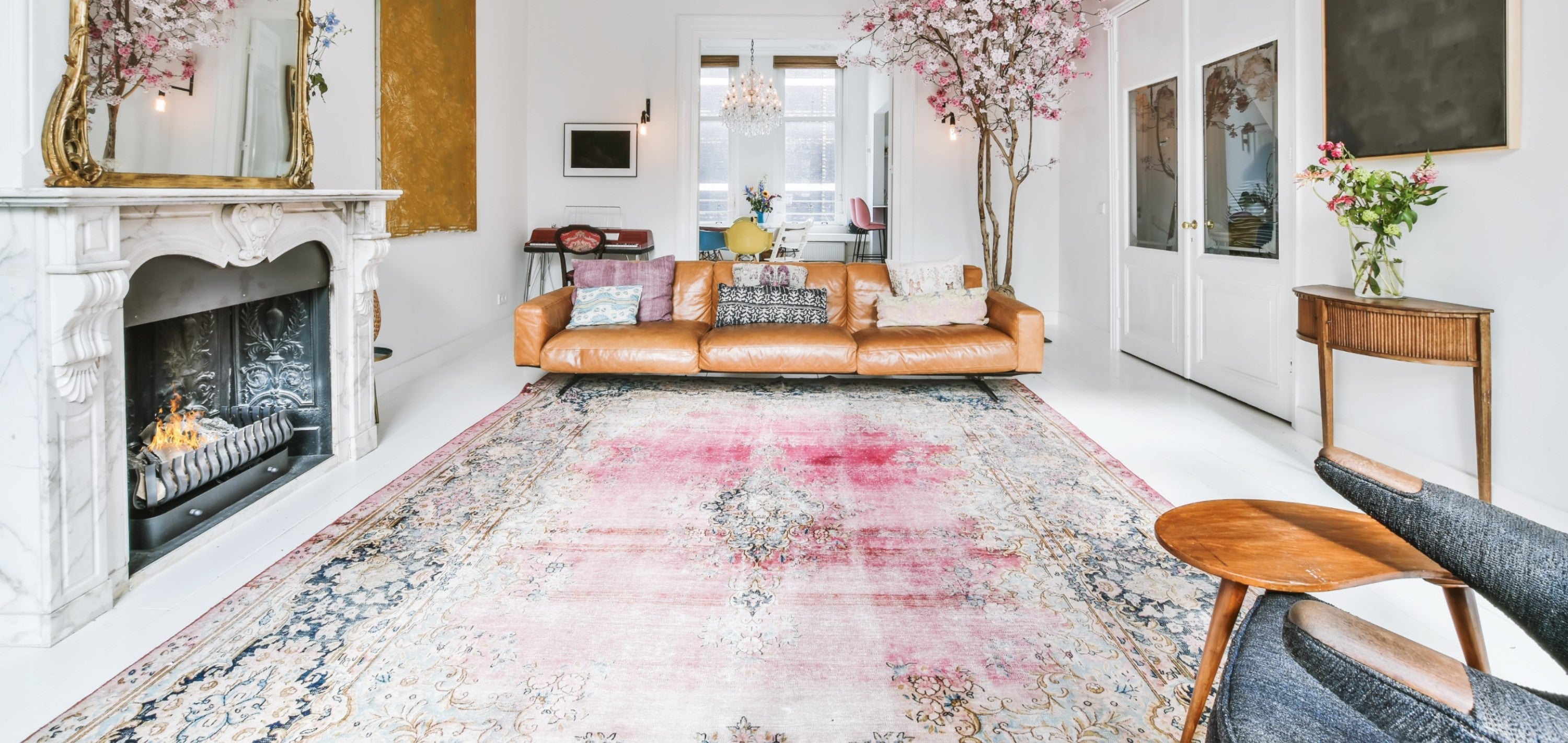
A rug works well in a conservatory, as long as you choose wool or a flat-woven kilim, a color with plenty of pattern rather than a single bold solid shade, and a size that leaves 30 to 40 cm of clearance from the glass wall. That way, you can account for the three things that make a conservatory more challenging than an ordinary room: lots of sunlight, wide temperature swings, and a cold, often slippery tiled floor.
Why is a conservatory different from your living room?
A conservatory or garden room has more glass than wall. That’s exactly why you enjoy spending time there, but it also means your rug has to put up with more than in the rest of the house. There are three factors at play:
- Direct sunlight. Sunlight shines through the glass onto the same spot for many hours a day. Over time, this causes every textile fiber to fade, including wool.
- Heat and cold. It gets warm on a sunny afternoon, then the room cools down considerably at night. In the colder months, condensation can form against the glass.
- The floor. Conservatories often have tiled, natural stone, or poured floors. They feel cold, and a rug can easily slide on them.
With the right choice, none of these three things is a reason to leave your conservatory bare. A rug makes the room feel warmer and calmer, and dampens the echo you often hear in a space with lots of glass and tile.
Which material should you choose for a conservatory?
Wool is the safest choice here. Wool can absorb moisture and release it again without feeling clammy, and it provides good insulation against a cold floor. Even when temperatures fluctuate, a handmade wool rug keeps its shape.
When it comes to wool, there are two options:
- A kilim is flat-woven, thin, and lightweight. It lies flat, dries quickly if water gets on it, and is easy to roll up if you use the conservatory less in winter. Learn more about the weaving technique in what a kilim rug is.
- A knotted wool rug has a pile and feels thicker and warmer underfoot. It’s a great choice if the conservatory is really a sitting room that you use in winter too.
Bamboo silk is beautiful, but less practical in a conservatory. It catches the light and therefore shows more quickly where the sun falls each day, and it is more susceptible to water from plants. Bamboo silk is better suited to a room with less direct light.
Materials at a glance
| Material | Sunlight | Moisture and plants | Cold floor |
|---|---|---|---|
| Wool kilim | Good, especially with lots of color and pattern | Good, dries quickly | Fair, thin rug |
| Knotted wool | Good | Good, but takes longer to dry | Good, feels warm |
| Bamboo silk | Less suitable, fading shows quickly | Less suitable, sensitive to water | Fair |
Which color stays looking good the longest in the sun?
A rule of thumb: the more pattern and shades a rug has, the less noticeable it is that it has been exposed to sunlight for years. On a solid, saturated color, a lighter strip stands out immediately. On a colorful kilim or a mottled vintage rug, gradual fading blends into the pattern.
Light, soft shades are also a smart choice for a conservatory. They fade just as much, but the difference from the rug’s original color is smaller, and they keep the room light and airy. Take a look at the beige and light vintage rugs. If you want to add color to your garden room, the colorful kilims pair well with the greenery outside.
Here are some other ways to help prevent fading:
- Turn the rug half a turn every three to six months so the same side isn’t always in the sun.
- During the sunniest hours, use a sunshade, roller blind, or UV-blocking film on the glass.
- Avoid leaving half the rug in the sun and half in the shade year after year. This creates a sharp line between the two.
How large should a rug be in a conservatory?
Leave 30 to 40 cm of bare floor around the rug, especially along the glass wall. That’s where it’s coldest in winter, and condensation can collect on the floor. If you have a door that opens out onto the garden, make sure it can swing freely over the rug.
Example calculation. Your conservatory is 400 cm wide and 300 cm deep. Leave 40 cm clear on the glass side and 30 cm on the house side. That leaves 300 - 40 - 30 = 230 cm of depth. Leave 40 cm clear on both sides of the width: 400 - 40 - 40 = 320 cm. A rug measuring around 300 x 200 cm will fit comfortably. If you only have a reading chair and a side table, 180 x 130 cm is often enough.
For comparison, the kilims in our collection are currently 175 to 300 cm long and 130 to 210 cm wide, as well as a kilim runner that is 80 cm wide. So there are rugs for both a small seating area and an entire garden room. If you’re unsure about your measurements, use masking tape on the floor to mark out where the rug will go.
Can a rug go on tile or underfloor heating in a conservatory?
Yes. Always use an anti-slip underlay on tile and poured floors. This stops the rug from sliding and provides a little extra insulation against the cold floor. In our article about choosing the right anti-slip underlay, you can find out which type is suitable for each floor.
Many conservatories have underfloor heating. A thin wool rug or kilim allows heat to pass through easily. Just make sure you choose an underlay that is suitable for underfloor heating. Find out more in our dos and don’ts for underfloor heating.
What not to do
- Place planters directly on the rug. Even a pot with a saucer can sweat or overflow. Put large plants on a plant caddy or beside the rug, and move the rug aside when watering.
- Place the rug right up against the glass. That’s where condensation and cold hit first. Leave a gap.
- Leave a damp rug lying out. If water gets on it, blot it dry and let it dry completely before laying it back down or rolling it up.
- Store a rug rolled up in a cold, damp conservatory. If you don’t use the conservatory in winter, store the rug indoors in a dry place.
- Choose based on the photo alone. In a conservatory, you see the color in full daylight. So take a look at a rug in a bright spot before you decide.
Frequently asked questions
Will a wool rug fade in a conservatory?
Yes, all fibers eventually fade in direct sunlight, including wool. With a colorful or mottled pattern, sun protection, and regular rotation, you’ll hardly notice it.
Is a kilim suitable for a garden room?
Yes, a kilim is one of the most practical choices for a garden room. It’s thin, lies flat, and dries quickly; with an anti-slip underlay, it also stays in place on tile.
Can a rug be left in an unheated conservatory?
That’s fine in summer. In winter, an unheated conservatory can get damp, so it’s better to store the rug indoors in a dry place.
A vintage rug in the conservatory brings the indoors and outdoors together. Every rug at Lavinta is handmade and unique, comes with a certificate of authenticity, and ships free within the EU. You have 14 days to decide, so you can take your time seeing how the rug looks in your own daylight.