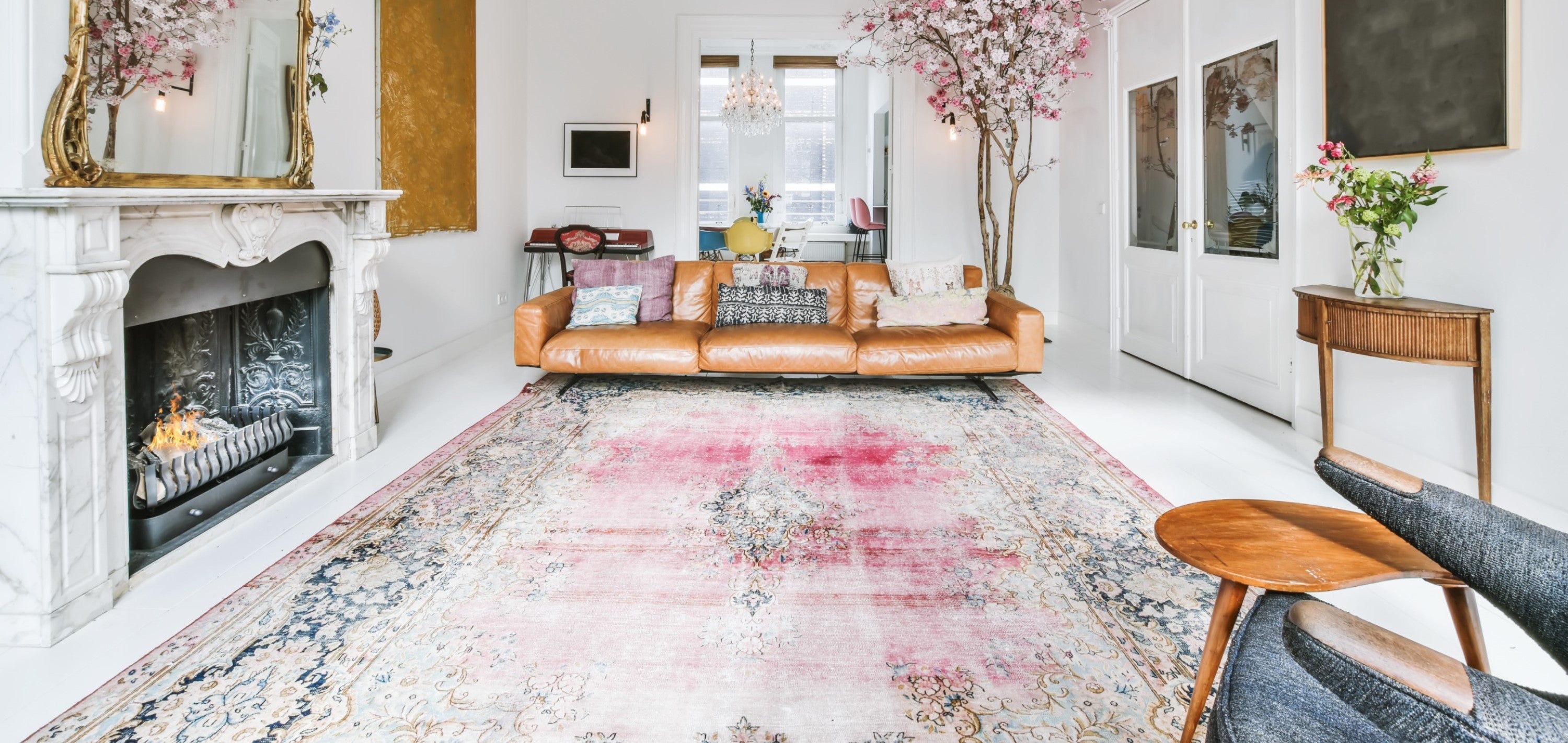
If you lay two vintage Turkish rugs side-by-side — one from Konya, one from Oushak — you'll see within three seconds that they come from different worlds. Different colors, different motifs, different knot density, different wool. Yet, they are both casually referred to as "Turkish vintage." This does a disservice to the richness of Anatolia. In this article, we'll delve into the most important weaving regions, the distinguishing features of each region, and how to learn to identify where a rug comes from.
What exactly is "Anatolian"?
Anatolia is the ancient name for the peninsula that largely comprises modern-day Turkey — roughly the area between the Aegean Sea, the Black Sea, and the Mediterranean Sea. It is one of the oldest rug-weaving regions in the world, with a tradition dating back to at least the 13th century, when Seljuk weavers in villages around Konya were already producing high-quality rugs for the sultans' mosques.
What distinguishes Anatolian rugs from, for example, Persian rugs, is the Turkish knot (also known as the symmetrical or "Ghiordes" knot): a double knot tied around two warp threads. This creates a sturdier pile, with slightly more relief in the design. Do you want to know how to distinguish a hand-knotted rug from a factory variant? Then read our guide on recognizing genuine hand-knotted vintage rugs.
Konya — the heart of ancient carpet weaving
Konya, on the central Anatolian plateau, is considered the cradle of Turkish weaving art. Rugs from this region (and the surrounding villages of Ladik, Karapınar, Obruk) are usually:
- Warm in color — deep red, terracotta, ochre, ivory.
- Geometric in motif — large medallions, stars, and tribal symbols like the "elibelinde" (the mother goddess figure).
- Robust in wool — plateau sheep's wool with a lot of lanolin, which makes the rug shiny and strong.
Konya rugs are often slightly thicker and heavier than rugs from more western regions. This makes them extremely suitable for living rooms with intensive use.
Kayseri — fine knots, refined design
Kayseri is located slightly northeast of Konya, at the foot of the extinct volcano Erciyes. For centuries, the city was a trade hub, and that cosmopolitan atmosphere is reflected in its rugs:
- High knot density — often 2,000 to 4,000 knots per dm².
- Refined, sometimes Persian-inspired motifs — floral medallions, prayer niches, fine borders.
- Blend of silk and wool in the more expensive variants.
For those who appreciate detail and are willing to pay a higher price, a vintage Kayseri is a real find. They are thinner than Konya rugs, and therefore more flexible to place under furniture.
Sivas — sturdy village rugs with tribal character
Sivas, in east-central Anatolia, produces rugs best described as "honest." Many are made by nomadic or semi-nomadic families, not in urban workshops. Characteristics:
- Sober color palette — often earthy tones, muted red, dark brown, ivory.
- Strict geometric design — diamond shapes, stepped borders.
- Slightly irregular proportions — not always perfectly rectangular, a sign of authentic tribal weaving.
Sivas rugs have a loyal following in modern interiors because they offer that raw edge that relaxes an overly neat interior.
Oushak (Uşak) — the world-famous rug
Oushak (Turkish: Uşak), in western Anatolia, is perhaps the best-known Turkish weaving region in Europe. From the 15th century onwards, Oushaks were exported to England and the Netherlands; they feature in dozens of paintings by Holbein and Vermeer. Characteristics:
- Soft, faded colors — often salmon pink, light yellow, gray-blue, ivory. Very different from the deeper palette of Konya.
- Large, open medallions instead of busy all-over motifs.
- Long pile which, through wear over the years, acquires a beautiful patina.
A vintage Oushak is one of the most "interior-friendly" Turkish rugs: soft in color, large in scale, calm in design. Perfect for modern spaces — we also wrote a separate guide about this: combining vintage rugs with modern interiors.
Hereke — the imperial workshops
Hereke is a coastal town near Istanbul where an imperial weaving workshop was established in 1843 under Sultan Abdulmecid I. Hereke rugs are internationally renowned for their extreme refinement:
- Up to 10,000 knots per dm² — truly very fine.
- Much silk, sometimes with gold or silver thread.
- Palace-like motifs, often with Persian influence.
Vintage Herekes are rare in the average European living room and fall more into the collector's item category.
Kelim — flat-woven, a separate category
Kilims are not knotted rugs, but flat-woven — warp and weft together form the design, without pile. They come from numerous Anatolian regions (Konya, Malatya, Kars, Mut). Characteristic:
- Graphic, often diamond-shaped patterns.
- Much red, indigo, and ivory.
- Lighter and thinner than knotted rugs.
A vintage kilim is extremely versatile: on the floor, on the wall, or even as a bedspread. View our kilim rug collection for a selection of authentic pieces.
How to recognize the region in practice?
Four practical questions that will quickly get you started:
- Which color family dominates? Faded salmon/soft = often Oushak. Deep red/ochre = often Konya or Sivas. Very refined and floral = Kayseri or Hereke.
- How fine is the knot? Place your finger flat on the back. Do you feel individual knots? Then it's coarser (Konya, Sivas). Does it feel almost smooth? Then it's fine (Kayseri, Hereke).
- How are the motifs arranged? Geometric tribal symbols → village or nomadic weaving. Symmetrical medallion with fine borders → city workshop.
- What does the pile do? Long and shaggy with patina → often Oushak. Short and tight → often Kayseri.
Why regional knowledge pays off
Knowing which region a rug comes from allows for more conscious purchasing. You're not just paying for a beautiful rug, but for a piece of cultural history with a provenance story. Moreover, regional knowledge helps in making the right interior choice: a finely knotted Kayseri fits into a space differently than a heavy Konya. For the full context of Turkish weaving culture and how to select a rug that truly suits you, we recommend our complete guide to vintage rugs.
Finally: every rug tells a story
Behind every Anatolian rug is a weaver — often a woman, often nameless, often working at a wooden loom in a village you will never visit. She used wool from her own sheep, vegetable dyes from the Anatolian landscape, and motifs that her mother and grandmother had already woven. When you place such a rug in your home, you're placing an entire history on your floor.
Curious about which regions we currently have in stock? View our vintage rug collection — each rug comes with origin information and context.