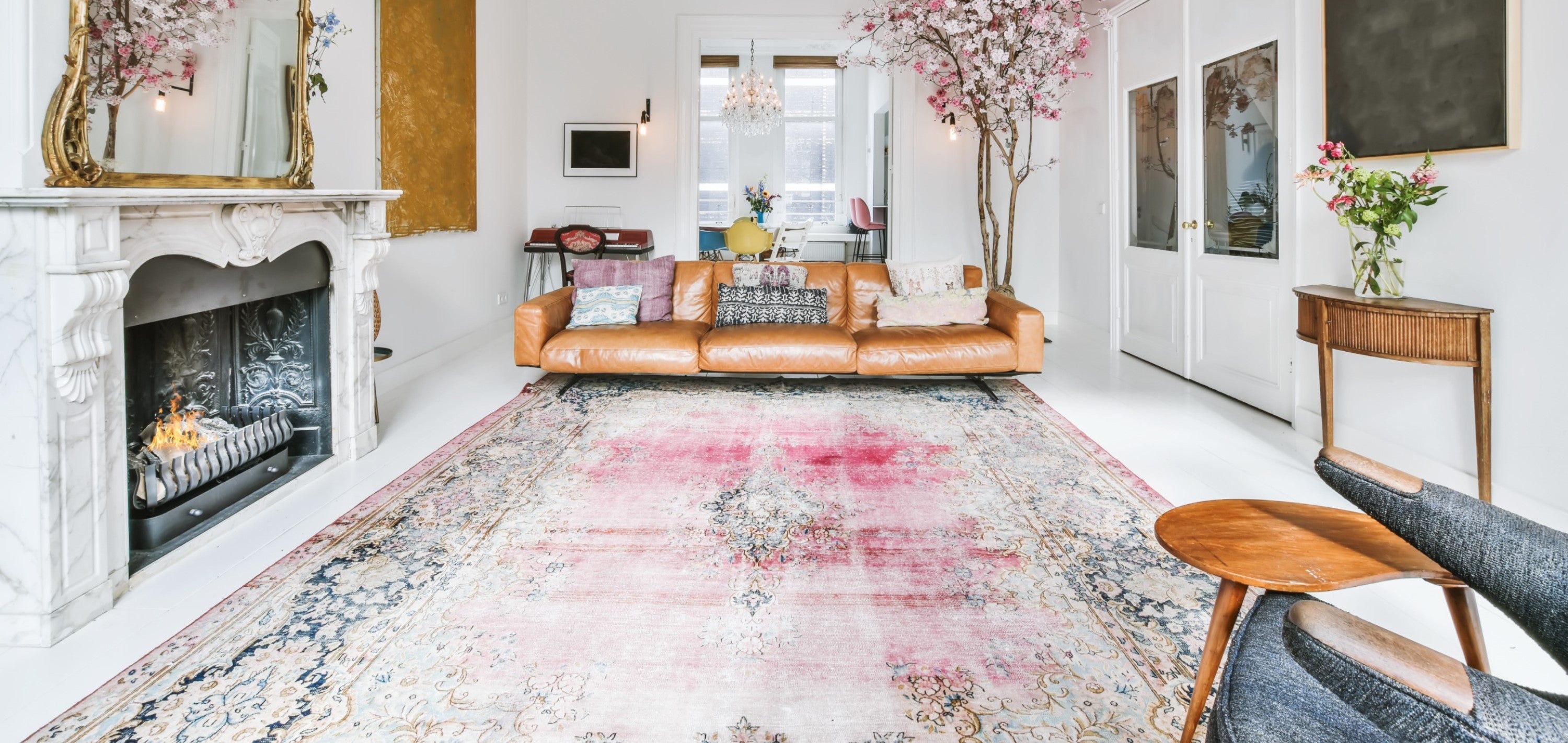
A sleek white minimalist interior with concrete-look floors, a cast-iron designer lamp, and an Italian sofa — and right in the middle: a hand-knotted Anatolian rug from 1955 with faded rust and bleached indigo. Does that clash? On the contrary. It's precisely that tension that makes a space interesting. In this article, we explain why vintage and modern are such a powerful duo, and which seven style rules help you do it right.
Why the combination works so well
A purely modern interior risks becoming sterile. Smooth glass, uniform paint, perfect corners — impressive, but without "breath." A vintage rug introduces the exact opposite: irregular knots, color variations, a patina that only comes with years of use. That contrast — perfection alongside imperfection — feels human.
Designers call this "wabi-sabi": the Japanese aesthetic where beauty lies precisely in wear and imperfection. A hand-knotted vintage rug is wabi-sabi in physical form. Place it in a clean, modern space, and suddenly that space comes alive. Want to know more about what defines vintage in the first place? Read our complete guide to vintage rugs.
Style rule 1: dare to choose scale contrast
A common mistake is to keep a vintage rug "small," as if it were an accessory. Do the opposite: go big. In a modern loft with high ceilings and sleek furniture, a spacious rug of 250 × 350 cm or larger works best. The rug thus becomes the visual anchor of the space, not a lost detail.
Rule: ensure that at least the front legs of every piece of furniture in the seating area are on the rug. No "floating" islands.
Style rule 2: one statement color, the rest neutral
Modern interiors thrive on calm. If you want to introduce a vintage rug with a striking color — such as deep indigo, terracotta, or moss green — make sure the rest of the room remains neutral. White walls, light oak, anthracite metal. The rug can shout, everything around it can whisper.
For example, look at the blue vintage rugs: a single deep indigo Anatolian rug in an otherwise stark white living room is enough to shift the entire atmosphere.
Style rule 3: play with texture, not with pattern
A busy vintage rug pattern pairs best with smooth, unpatterned furniture. Do you already have a tweed sofa or a tapestry armchair? Then choose a calmer rug, such as a plain kilim or a faded Oushak with a large, open motif. In that case, check out our kilim collection — flat-woven, graphic, and visually calmer than most pile rugs.
Rule of thumb: one busy pattern per viewing area. Two busy patterns at once will always compete.
Style rule 4: respect the color temperature
Modern interiors are often "cool": gray, white, black, steel. Vintage rugs are almost always "warm": red, rust, orange, ochre, brown. That warmth is exactly what a cool interior needs — but only if you use it deliberately.
Carry the warmth of the rug through to at least one other element in the room: a terracotta vase, a tan leather chair, a cushion in the same color family. This way, the rug feels connected, not "parked."
Style rule 5: combine old with truly new, not with "vintage-look"
A genuine vintage rug next to an industrially styled "vintage look" sofa from a chain store — something is off. The eye immediately sees that one is authentic and the other feigned. Therefore, place a genuine vintage rug with genuinely contemporary design (a Hay sofa, a Vitra chair, a contemporary concrete coffee table) rather than with faux-vintage.
The combination becomes: genuinely old next to genuinely new. Both have character, neither pretends to be something else.
Style rule 6: use the rug to define zones
Open floor plans — typically modern — often have the problem that the living room, dining room, and kitchen visually flow into each other without clear demarcation. A vintage rug under the seating area acts as a "room within a room." The eye immediately understands: this is for sitting, that is for eating.
Practical tip: let the rug extend at least 20 cm beyond the armrests of your sofa on the sides. The rug should always extend under the coffee table.
Style rule 7: respect the age
A 70-year-old vintage rug is not a rug to place in the hallway where wet shoes will walk over it. Protect the investment with a good underlay, rotate it twice a year for even wear, and keep it out of direct sunlight (which fades it more than you'd like).
Want to know how to truly distinguish whether a rug is authentic vintage and not a factory product with a "vintage finish"? Read our guide on recognizing genuine hand-knotted vintage rugs.
Common mistakes in modern interiors
- Too many competing statements. Designer lamp + designer chair + busy art + busy rug = visual chaos. Choose a main player.
- Wrong size. A rug that looks like a floating island in the middle of the room breaks the modern aesthetic, rather than enhancing it.
- Laid out too perfectly. A vintage rug can have a slight crease, a corner can lift a little. Don't try to make it "styling-perfect" — imperfection is part of its charm.
- Vintage rug on vintage carpet tiles. Or a vintage rug on another vintage rug in the room. Too much old on old feels stifling in a modern setting.
Practical example: an Amsterdam loft
One of our clients has a loft on Prinseneiland: concrete floor, white walls, black steel window frames, a grey Vitsoe cabinet, and a simple white sofa. She chose a 300 × 400 cm Oushak from Anatolia with a faded salmon-to-terracotta field and sparse blue details. The end result: the room was immediately "complete." The rust tone of the rug was picked up by two terracotta vases, the blue details by a single cushion. Nothing too much, everything in dialogue.
In conclusion: vintage makes modern liveable
Modern design is at its best when it has something to rub up against. A vintage rug provides that friction without eating into the clean lines. It brings history, color, warmth, and imperfection — four things that contemporary design often lacks.
Browse our complete vintage rug collection and filter by size or color. Unsure about a combination with your interior? Feel free to send us a photo of your room; we'd be happy to advise.