Reader time: approximately 10 minutes. This guide teaches you everything you need to know before buying a vintage rug.
A vintage rug is more than just a carpet. It's a hand-knotted piece of history that transforms your floor into the most personal part of your home. In this complete guide, we'll tell you everything: from material and origin to maintenance and buying advice. We write this from over ten years of experience with Turkish hand-knotted carpets — and annual trips to local artisans to personally select the most beautiful pieces.
1. What is a vintage rug?
A vintage rug is a carpet that is truly old: usually 20 to 60 years old or even older. It is hand-knotted in Turkey, Iran, or another carpet-producing country, then used for years or decades, and subsequently carefully restored for a second life. This process creates the typical 'vintage softness': subtly discolored patterns, a low-pile that feels soft, and wool that has acquired its natural sheen over the years.
No two vintage rugs are identical. Each piece is unique — literally one of a kind. That's why at Lavinta, we say: once it's gone, it's gone.
👉 Also read: the difference between a vintage and retro rug
2. Why choose vintage?
Four reasons why people keep coming back to us for their vintage rug:
- Character and uniqueness: A hand-knotted pattern has no copy. You can be sure no one else has the same rug.
- Sustainability: No new production, no synthetic fibers. A rug that lasted decades will last decades more.
- Quality: Wool is naturally durable, stain-resistant, and breathable. Some of our rugs are 50+ years old and still in top condition.
- Ambiance: Vintage breaks the austerity of modern furniture. It works in any style — boho, Scandi, classic, industrial.
3. Materials — why wool almost always wins
The vast majority of vintage rugs are made of 100% wool. And there's a good reason for that.
Wool
Wool is a natural fiber with unique properties: it naturally repels stains due to its lanolin layer, it is fire-retardant, breathable, insulating, and lasts for decades without visible wear. Wool carpets even get more beautiful with age — the sheen increases, the colors gain depth.
Cotton
Cotton is often used as a base (the warp to which the wool knots are attached). Sometimes you also see light summer rugs made entirely of cotton — these are cooler in summer but less durable than wool.
Silk
Silk is luxurious and has a unique sheen, but it is softer and less durable. Often used in fine Persian carpets — not typical for the vintage Turkish rugs we carry.
Synthetic (what to watch out for)
Cheap carpets often use polyester or polypropylene. These feel like plastic, melt with heat, and break down after only 3-5 years. A vintage carpet should never be this — always ask for 100% wool.
4. Styles and origin
Most vintage rugs come from a handful of regions with rich weaving traditions:
Turkey (Anatolia)
Our main source. Anatolia has a 700+ year old knotting tradition. Well-known regions include Konya, Sivas, and Cappadocia. Turkish rugs often use the Gördes knot (double) and have warm, earthy tones with geometric patterns.
Iran (Persia)
Persian carpets are famous for their fineness and floral motifs. Tabriz, Heriz, Kashan — each area has its own characteristics. Persian work is often more expensive due to finer knot density.
Morocco
Berber carpets from the Atlas Mountains, with thick pile and minimalist patterns (think Beni Ourain). A different vibe than Turkish — often cream with black lines.
What will you find at Lavinta?
Our collection focuses on Turkish vintage rugs: hand-knotted, washed, and low-pile for a contemporary look. We travel to Turkey ourselves annually to select them on site.
5. How is a vintage rug made?
Two techniques you'll often encounter:
Hand-knotted
Knot by knot, often hundreds of thousands per rug, sometimes over a period of months to a year. These are the classic Turkish and Persian carpets — thick, durable, and recognizable by the regular knot pattern on the back of the rug.
Hand-woven (kilim)
Woven instead of knotted. Result: a flat, thinner rug without pile. Ideal as a low-profile rug or for warmer climates. Both techniques are centuries old and handcrafted.
👉 Check out our kilim collection if you are looking for a hand-woven rug.
6. The Lavinta process: from weaving mill to your living room
What sets us apart — and why our customers give us 9.7/10 on WebwinkelKeur — is our selection and restoration process:
- On-site selection. We travel to Turkey annually and visit local artisans and families with collections of old carpets. No intermediaries, no export warehouses — direct selection.
- Restoration. Each rug is carefully washed, minor damage is repaired, and then low-piled for a modern look.
- Quality check. Only rugs that meet our standards in terms of color, pattern, and condition come to the Netherlands.
- Own stock. Everything is immediately available from our Dutch warehouse. No waiting for imports.
That makes every purchase a safe choice: you see what you get, it's immediately available, and you have 14 days to view it to see how it looks in your room.
7. How to choose the right size?
Size is the most important practical consideration. Too small = the rug 'floats'; too large = it overwhelms the space. Rules of thumb:
- Living room: minimum 200×300 cm, ideally 240×340 cm (sofa and coffee table are both on the rug).
- Dining room: choose a size where chairs, when pushed back, are still on the rug — usually 240×340 cm or larger.
- Bedroom: 170×240 cm to 200×300 cm, with the bed partly or fully on the rug.
- Hallway or kitchen: consider a vintage runner — narrower and longer, ideal for passage areas.
👉 Read the extensive size guide with visual examples
8. What color suits your room?
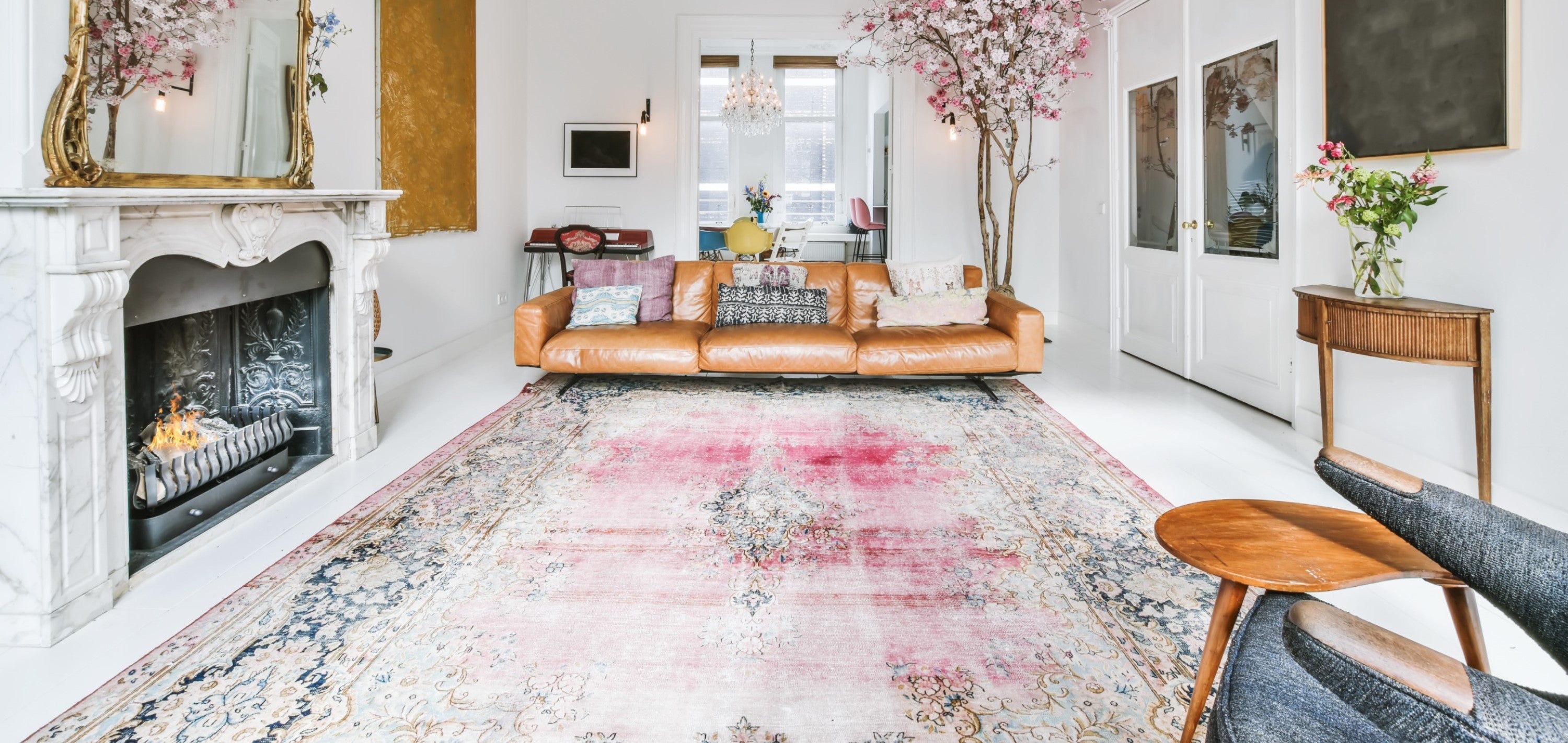
With vintage, contrast works. A warm orange-red rug fits especially well in a white, minimalist room. A dark blue vintage works well under a light sofa. A few tips:
- White/grey interior: choose a colorful vintage — pink, red or blue.
- Colorful interior: choose a more neutral vintage — beige, grey or black.
- Boho style: warm earthy tones — orange or yellow always work.
- Classic/rural: dark red, dark green, or green vintage.
9. Maintenance and lifespan
A good vintage rug will last decades — provided you treat it normally:
- Vacuuming: weekly, on a normal setting (no brush roll directly on the pile).
- Stains: blot immediately with a clean, white cloth. Never rub. Salt or baking soda helps absorb moisture.
- Deep cleaning: 1x every 1-2 years a professional wool cleaning. Do not steam yourself — wool shrinks at the wrong temperature.
- Rotate: turn the rug 180° every 6 months for even wear and color development.
- Under heavy furniture: use felt glides to prevent indentations.
10. Common pitfalls when buying vintage
- Overstated claim 'truly vintage' — ask for proof of age. We can trace each rug to its region and estimated production period.
- Unclear material specification — if it states 'wool blend' or 'mix': likely synthetic.
- Foreign supplier without local storage — we keep stock in NL, no weeks of import waiting time.
- No return policy — we offer 14 days for viewing so you can see how it works in your own room.
- Too low price — a genuine hand-knotted vintage costs at least a few hundred euros. Under €100 is almost certainly a reproduction or synthetic.
11. Frequently Asked Questions
What does a vintage rug cost on average?
At Lavinta, our vintage rugs start from €199 for smaller pieces, with most ranging between €299 and €499 for living room sizes. Special pieces (larger, fine knot) can be €600+.
How old are your vintage rugs?
Most are 30-60 years old. Sometimes we have pieces up to 80 years old.
Can I use a vintage rug in a home with children or pets?
Yes. Wool is naturally durable and stain-resistant. Vintage rugs have already seen decades of use — they are 'proven durable'.
What is the difference with a retro rug?
Vintage = truly old (20+ years). Retro = style designation, can be recent. At Lavinta, you'll only find genuinely vintage. Read the explanation →
Do you also have runners?
Yes — view our runner collection for narrow vintage rugs in the hallway or kitchen.
Does vintage work with underfloor heating?
Yes, wool is a good heat conductor and works perfectly under a wool carpet. However, a slightly thicker underlay is recommended to prevent heat build-up.
12. Conclusion
A vintage rug is a unique purchase. No two are identical, they become more beautiful with age, and they instantly add character to any space. Whether you're looking for a small pink runner for the hallway or a stately blue rug under the dining table — there's always a vintage rug that fits.
At Lavinta, we personally select each piece, restore them with care, and keep them in our own stock for immediate delivery. With 9.7/10 on WebwinkelKeur (353+ customers), you know you're in good hands.
→ View the complete Lavinta vintage collection
Questions? Contact us — we'd be happy to advise you personally.
Further reading
Check out our retro rugs and all vintage rugs.