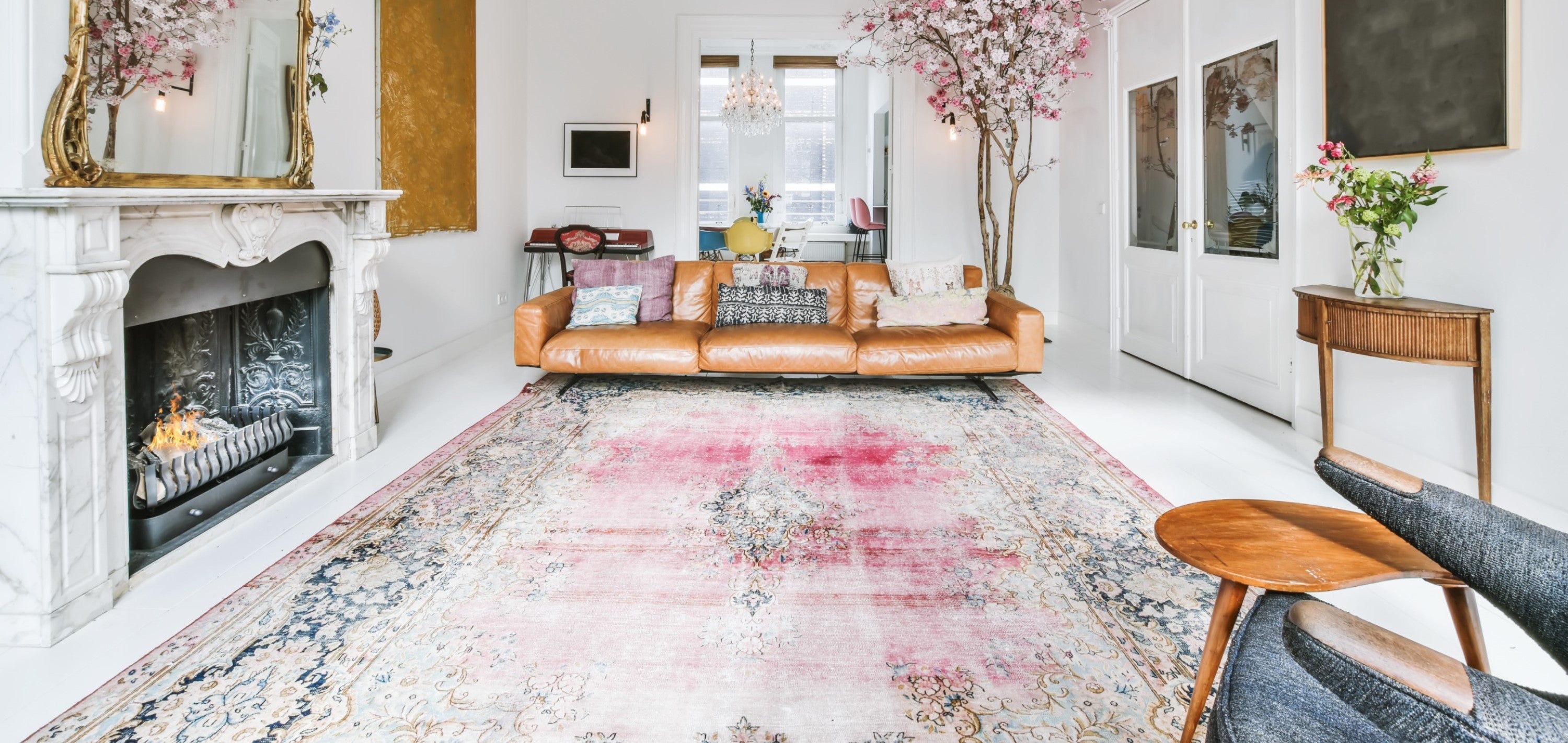
You're in your bedroom, a beautiful vintage rug in your hands — but where exactly do you place it? Half under the bed? Completely under it? Or perhaps even two separate runners on either side? The answer changes depending on the bed size, bedroom layout, and aesthetic goal. In this guide, we'll walk you step-by-step through all scenarios, with concrete measurements and examples ranging from Anatolian living rooms of a hundred years ago to Dutch city apartments today.
Why a vintage rug belongs in the bedroom
The bedroom is the first place you set foot on the floor in the morning. No place is better suited for the soft, dense wool of a hand-knotted Turkish rug. Vintage rugs bring three qualities that are invaluable in a bedroom: sound dampening, thermal insulation against cold floors, and a visual anchor that balances busy bed linen or a patterned curtain fabric.
Moreover, old Turkish rugs often have a softened color palette — decades of sunlight and use have given the wool a patina that newly woven rugs simply lack. This patina has a calming effect, especially in a space intended for rest. Do you want more background on what a vintage rug is exactly and how to recognize it? Then read our complete guide to vintage rugs.
The three classic placement options
Before we get to exact measurements, first the three standard variations that almost every bedroom layout comes down to:
- Completely under the bed — the rug extends about 50 to 80 cm beyond the bed on three sides (foot and both sides). This gives the most luxurious look and ensures you always step softly onto the rug.
- Two-thirds under the bed — the rug starts at the height of your nightstands and extends past the foot end. The nightstands are on the floor, the bed is on the rug. Practical and visually strong.
- Two separate runners — a narrow kilim or small vintage rug on each side of the bed. Especially nice for small bedrooms or if you want to continue showcasing an expensive wooden floor.
Sizes per bed size — the concrete figures
Now for the actual calculations. Always allow for at least 50 cm of visible rug on the exposed sides of the bed; 70 to 80 cm feels even more luxurious.
Single bed (90 × 200 cm)
A single bed is best suited for option two or three. A rug of 170 × 240 cm completely under the bed leaves about 70 cm visible at the front and outer side. If you only want to accentuate one side (bed against the wall)? Then choose a runner of 80 × 250 cm that runs alongside the bed.
Double bed (140 × 200 cm)
The most popular size in the Netherlands. Here, vintage rugs of 200 × 290 cm or 200 × 300 cm work perfectly for the two-thirds option. Do you want the bed entirely on the rug? Then go for 250 × 300 cm or larger. A smaller rug of 170 × 240 cm at the foot end is possible, but it quickly looks meager with a double bed.
Queen / 160 × 200 cm
A popular intermediate size. Count on 240 × 300 cm for completely under the bed with 40 cm overhang, or 250 × 350 cm for that true hotel feeling.
King size (180 × 200 cm or larger)
A king-size bed demands a statement. For the two-thirds option, you'd use 250 × 350 cm; for the entire bed to be on the rug, you'd move towards 300 × 400 cm. At these sizes, a vintage Oushak or large Anatolian kilim is often more aesthetically pleasing in scale than a more busily patterned rug — large rugs with too much detail can become restless.
Color and color temperature in the bedroom
Bedrooms require colors that lower the heart rate. This often means: muted, warm, and not too high-contrast. Three color families that almost always work well:
- Warm earth tones — terracotta, rust, camel brown, old rose. Works perfectly with linen bedding and wooden furniture.
- Softened blues — think faded indigo or grayish-blue. Check out our collection of blue vintage rugs for inspiration. Combines beautifully with white and light oak.
- Neutral tones — ivory, beige, taupe, soft anthracite. Ideal if your wall hanging, bedding, or curtains already make a statement.
In a bedroom, avoid sharp, high-contrast combinations (bright red next to deep black, for example) — these create energy in a living room but can unconsciously keep your brain active in a bedroom.
Under the bed legs or in front?
A common question: should the bed legs be on the rug, or just in front of it? Both are possible, but there are guidelines:
- For a low bed with a solid base (box spring, platform bed), most people place the bed completely on the rug. This looks calm and sturdy.
- For a bed with ornate legs (French, colonial, antique), you can also choose to place only the front part on the rug, so the legs remain visible.
- A two-runner setup works best with any type of bed, provided the bedroom is wide enough for symmetrical placement.
Safety: anti-slip and fastening
You get up sleepily in the morning, often barefoot. A slipping rug is literally an accident waiting to happen. For vintage wool rugs, we generally recommend a thin anti-slip underlay. This also protects the pile on the underside from pressure from bed legs and thus significantly extends its lifespan. For further care instructions, read our guide on vintage rug maintenance.
Bedroom with underfloor heating?
More and more Dutch bedrooms have underfloor heating. Good news: a hand-knotted wool vintage rug can be excellently combined with it, provided you take a few things into account (thermal resistance, heating up, the type of underlay). We have a full article on this: vintage rug and underfloor heating.
Common mistakes
- Bought too small. A 120 × 170 cm for a double bed looks like a postage stamp. Better to go one size larger.
- Pattern that clashes with bedding. Do you have floral or geometric bedding? Then choose a calmer rug (plain field, border motif only).
- Wrong side facing forward. With asymmetrical vintage rugs, the focal point of the pattern usually belongs towards the headboard — not towards the door.
- No underlay. Besides safety, it also prevents fine dust from accumulating between the rug and the floor.
Finally: vintage is always unique
The beauty of a vintage rug is that no two are exactly alike. Every rug in our vintage rug collection is hand-knotted by a real weaver, used for years, and has its own story. In a bedroom — the most personal space in your home — that's exactly what you want: not one of a thousand, but one of one.
If you're torn between two sizes? Almost always choose the larger one. A rug that is slightly too big looks generous. A rug that is too small looks unfinished.